Prison Life: Idle Game
- 4.2
- Rating
- 50.00M
- Installs
- Free
- Price

 Analysis by App-foxy
Prison Life: Idle Game immediately puts me in the unusual position of running a prison rather than escaping from one. That change of perspective gives this free role-playing game a simple hook: I am responsible for keeping a growing population under control while turning a difficult facility into something that functions smoothly. It is a light management experience from Supercent, Inc., designed for short sessions and gradual progress rather than deep simulation.
My first impression was that the game is easy to understand, but not completely empty. The setting supplies a clear visual identity, and the prison theme gives ordinary management tasks a little more personality than a generic shop or factory. I can see why it has attracted a broad audience: it has an average rating of 4.4 from around 121 thousand ratings, and it has passed 10 million installs. Those figures suggest that its quick, accessible format works for many players, though they do not change the fact that this is a fairly casual take on the genre.
Running a prison with a clear visual identity
I found the prison setting gives this management game a stronger identity than a routine of upgrades alone. In this section, I look at how its visual world makes the manager role easy to grasp, while also considering the practical choices that can make each short visit feel purposeful.
You May Also Like

 AccuWeather: Weather Radar
AccuWeather Review: A Quick, Clear Forecast for Everyday Decisions
For everyday plans, the best forecast is the one you can understand quickly. AccuWeather makes rain timing, radar, and local conditions easy to act on, with a few trade-offs.

 Hill Climb Racing
Why Hill Climb Racing Still Turns Crashes Into One More Run
A tiny car, a bumpy hill and one more upgrade: Hill Climb Racing keeps resurfacing because its simple chaos makes every near-miss feel personal.

 AliExpress - Shopping App
AliExpress Makes Global Shopping Feel Personal, but Shoppers Bear the Risk
AliExpress turns a global marketplace into a pocket-sized discovery engine. Its reach is useful, its shopping loop compelling, and its trade-offs easy to miss.

 Lords Mobile: Kingdom Wars
Lords Mobile Is a Kingdom-Building Routine, Not a Quick Match
A case-by-case verdict on the building, battles, device demands, and social commitments that make Lords Mobile rewarding for some players and exhausting for others.

 PDF Scanner app - TapScanner
TapScanner Makes Paperwork Easier to Capture, Check, and Share
TapScanner makes scanning with a phone feel less like a rescue operation and more like a dependable step in getting work done. Its capture tools are useful, though not flawless.

 Block Blast!
 Shows How Much a Puzzle Game Can Leave Out
A quiet grid game shows why puzzle players increasingly value instant clarity, repeatable skill and low-pressure play—and where the genre still needs to catch up.
More From Our News Desk
View All News


A first session that explains its priorities
The game is built around a straightforward fantasy. Prisoners arrive, the facility needs attention, and I have to make decisions that help the operation keep moving. The appeal is not in mastering a complicated ruleset on the first attempt. Instead, it comes from watching a place develop as I make small improvements and deal with the pressure created by a larger population.
That simplicity is useful on a phone. I do not need to memorize a long series of systems before I understand what matters. The game presents its objectives in a way that encourages me to act, observe the result, and then decide what deserves attention next. This makes it approachable for someone who normally avoids management games, while still giving experienced players a familiar loop to settle into.
What I like most is the contrast between the serious subject matter and the approachable presentation. The prison is recognizable enough to establish the mood, but the game does not treat itself like a harsh documentary or a detailed simulation. Its tone is closer to an animated management challenge, which keeps the experience comfortable for its Everyone content rating and makes the theme easier to engage with casually.
Who will feel at home here
I would recommend it first to players who enjoy watching a place grow through repeated small actions. If you like idle games, compact management tasks, and role-playing titles that give you a clear responsibility without demanding constant concentration, this is a good fit. It also works for people who want something they can check between other activities rather than a game that requires a long uninterrupted evening.
A realistic use case is a short break during the day. I can open the game, review what is happening in the prison, make an improvement, and leave once the next priority is clear. That rhythm suits a commute, a coffee break, or the few minutes before bed. The prison theme gives those small decisions a stronger identity than simply upgrading anonymous buildings.
On the other hand, I would not choose it for a player looking for a serious prison simulator, a story-heavy role-playing adventure, or a system-rich strategy game. The accessible design is also its main limitation. If you want detailed staff scheduling, complex prisoner personalities, or a carefully modeled economy, this experience may feel too light. A traditional strategy title would be a better choice when the pleasure comes from solving layered problems rather than maintaining a steady flow of progress.
The visual language of the setting
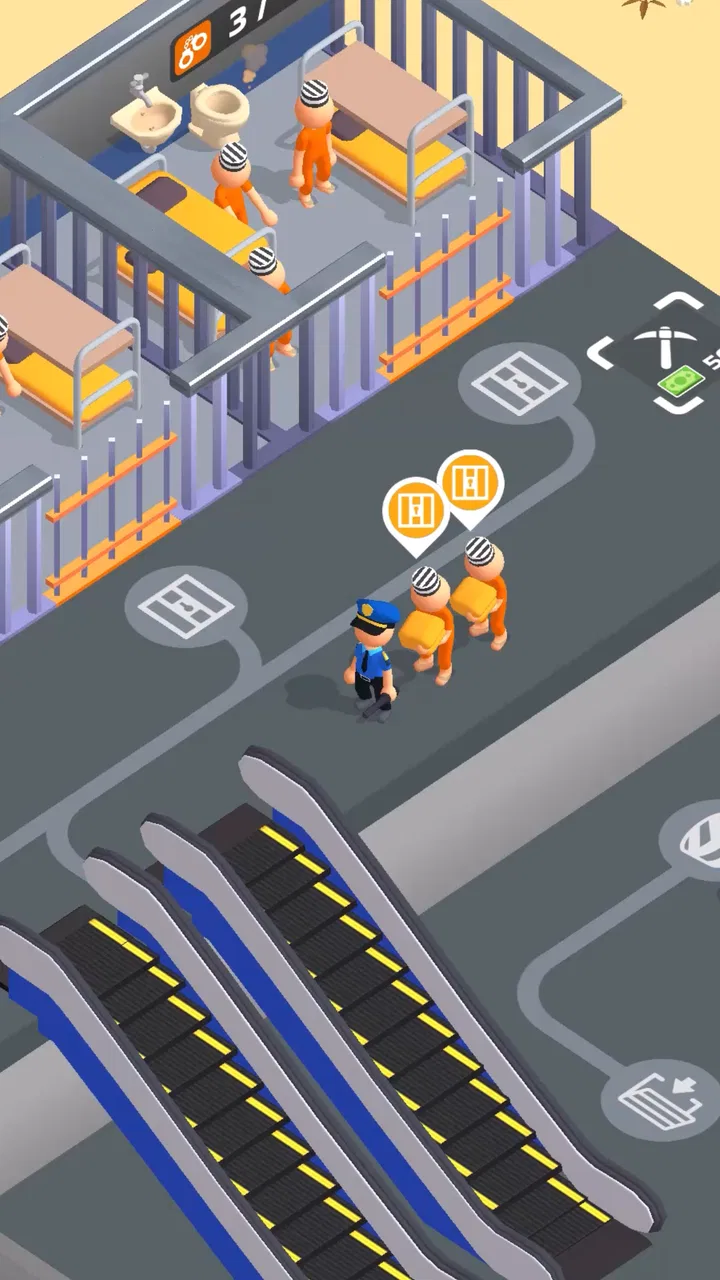
The art direction does important work because the basic loop could otherwise feel abstract. Corridors, cells, work areas, and the movement of prisoners create a readable visual vocabulary. I can understand the state of the facility by looking at it, rather than treating every decision as a number hidden in a menu. That clarity matters on a small screen, where clutter quickly becomes tiring.
The prison setting also gives upgrades a natural context. Improving a facility feels connected to the idea of making the institution more capable, while the arrival of more prisoners creates an obvious reason to keep expanding. This is more effective than placing the same mechanics in an interchangeable city or business environment. Even when an action is mechanically familiar, the environment reminds me why it matters.
There is a useful balance in the presentation. The game can acknowledge the confinement theme without making the screen visually oppressive. It uses the setting as a frame for management rather than trying to turn every moment into a grim moral drama. For me, that makes it easier to play for longer periods, although some players may find the softened tone less compelling than a more mature interpretation.
Why the world feels coherent
The strongest part of the setting is the way the visual theme supports the central responsibility. I am not simply collecting resources because a tutorial tells me to; I am trying to keep a prison operating while its population grows. That connection gives the loop a sense of direction. The environment, the role I occupy, and the need to improve the facility all point toward the same fantasy.
One practical tip is to pay attention to what the layout communicates before tapping through upgrades. In a game like this, the most useful decision is not always the most visually prominent one. I find it more satisfying to identify the part of the facility that is creating a bottleneck, then spend progress there, rather than upgrading randomly. This turns the simple loop into a small exercise in prioritization.
Sound, feedback, and the pace of play
The audio experience supports the setting without becoming the main attraction. The prison atmosphere benefits from sound cues that make actions feel connected to a working facility, while the visual feedback keeps the progress easy to follow. I do not play this expecting a dramatic soundtrack or elaborate sound design. Its job is to reinforce the feeling that the prison is active, and it generally serves that purpose.
The more important element is rhythm. The game alternates between moments when I make a decision and periods when progress can continue in the background. That is the defining comfort of an idle structure: I am not required to be present every second for the facility to feel alive. When I return, there is usually a reason to inspect the situation and decide what to do next.
This rhythm is particularly effective when I treat the game as a routine rather than a race. I can make a few deliberate changes, close it, and return later with a fresh view of the next problem. Players who prefer constant action may find this slow, but players who enjoy gradual accumulation will appreciate how little pressure it places on each individual session.
The trade-off is that the same pacing can become predictable. Once I understand the pattern of checking progress, making an upgrade, and waiting for the next opportunity, the excitement depends heavily on whether the current development goal feels meaningful. The prison theme helps maintain interest, but it cannot completely disguise a loop that may feel repetitive to anyone who needs frequent surprises.
How to use the idle rhythm well
I get better results when I avoid tapping through every available action immediately. Instead, I look at the prison as a queue of needs. If the number of prisoners is increasing, I consider whether the facility can support that growth before spending on something merely convenient. This approach makes the waiting periods useful because I already have a plan for the next return.
Another helpful habit is to separate active play from passive progress in my expectations. During an active session, I want clear feedback and a decision worth making. Between sessions, I accept that the game is doing less and simply building toward the next checkpoint. That distinction prevents the idle design from feeling like a lack of content; it is meant to make progress fit around my day.
Where the mechanics fit the mood
The management mechanics and the prison atmosphere complement one another because the setting gives every improvement a visible purpose. I am not only chasing abstract growth. I am trying to manage the flood of prisoners and keep the institution functioning. That produces a gentle form of pressure: expansion is attractive, but expansion also creates more responsibility.
This is where the role-playing label makes sense in a broad, accessible way. I am stepping into the role of a prison manager, and my choices shape how the facility develops. It is not role-playing through long dialogue scenes or a heavily scripted character arc. Instead, the role comes from the viewpoint and the responsibilities attached to it.
The mechanics are at their best when they ask me to choose between immediate comfort and longer-term capacity. A quick improvement can make the current situation easier, while a larger investment may prepare the prison for future growth. These decisions are not brutally difficult, but they create enough friction to keep the process from becoming a completely passive screensaver.
One non-obvious strength is that the theme helps me notice inefficient play. In a generic idle game, I can spend resources without thinking because every upgrade looks like another percentage of progress. Here, the idea of a functioning prison encourages me to ask whether a change solves an operational problem. That small mental shift makes the same style of progression feel more grounded.
Free access and the question of spending
The game is free to download, which makes it easy to try without committing money first. It includes in-app purchases priced from $3.99 to $9.99 per item. I would approach those purchases as optional acceleration rather than part of the basic reason to install it. The core appeal is the management loop and the atmosphere, so I would first decide whether those are enjoyable at the ordinary pace.
My advice is to play long enough to understand the normal rhythm before considering any purchase. If the waiting periods already feel relaxing, paying to move faster may reduce the very pacing that makes the game comfortable. If the slower progress feels frustrating, a purchase might make the experience more convenient, but it will not transform the game into a deeper simulation.
This is also where the title may divide players. Someone who enjoys gradual improvement can see waiting as part of the design. Someone who wants to make several meaningful decisions in every session may experience the same structure as a restriction. Neither reaction is wrong; the right choice depends on whether you want a calm background game or a demanding management challenge.
Device access and practical expectations
The game runs on Android devices using version 6.0 or later, so it is available to a wide range of phones and tablets. Its simple presentation is a practical advantage for players who do not want a visually demanding role-playing game. I still recommend keeping expectations realistic: broad device compatibility does not turn the experience into a large-scale simulation with endless complexity.
The current version is 44.2.0, and that makes it sensible to keep the app updated through the normal store process so the experience matches the maintained release. I would also remember that idle games are most enjoyable when notifications and play sessions fit personal habits. If frequent reminders are distracting, I would keep them limited; if I like checking progress throughout the day, the structure supports that behavior.
Where it stands beside other role-playing games
Compared with story-focused role-playing games, this one is much less concerned with character development, exploration, and combat. Its identity comes from managing a place and watching its operation expand. That makes it easier to enter, but it also means there is less narrative motivation for players who want a strong cast or a dramatic journey.
Compared with conventional idle management games, the prison setting gives it a more distinctive personality. The visual language and the responsibility of handling prisoners make the loop easier to remember. The cost is that the theme may not appeal to everyone, even in its softened presentation. A city builder is a better alternative if you want a more neutral or optimistic setting; a serious strategy game is better if you want detailed consequences and long-term planning.
Compared with action-oriented mobile games, Prison Life: Idle Game is far less demanding. There is no need to maintain reflexes or learn a complicated control scheme. That makes it suitable for relaxed play, but not for someone who judges a game mainly by moment-to-moment excitement. I see it as a companion game, not a replacement for a full-length adventure.
The small decisions that make it more enjoyable
My first practical recommendation is to identify the facility’s current bottleneck before spending resources. Growth is satisfying, but an upgrade that does not address the immediate pressure can leave the prison feeling just as constrained afterward. Thinking in terms of capacity and flow gives the otherwise simple choices more weight.
Second, I would use the game’s short-session nature deliberately. Rather than leaving it open and tapping without a plan, I set a small objective for each visit: improve the area that is slowing progress, prepare for the next increase in prisoners, or simply collect what has accumulated and stop. This keeps the game from turning into repetitive maintenance.
Third, I would judge the atmosphere separately from the progression speed. If I enjoy the prison visuals, the manager’s viewpoint, and the quiet sense of a facility becoming more capable, the game can remain pleasant even when the next upgrade takes time. If those elements do not interest me, faster progress will probably not solve the underlying mismatch.
Who should skip it
I would skip this game if I want a realistic examination of prison administration. The accessible tone and idle structure are designed for broad entertainment, not for modeling the ethical, legal, and logistical complexity of real institutions. I would also skip it if I need every session to introduce a new mechanic or a major story beat.
It is less suitable for players who dislike waiting-based progression, even when the waiting is part of a larger management loop. The same applies to anyone who prefers direct control over every event. Here, the satisfaction comes from setting priorities and observing development, not from personally handling every prisoner or solving every problem in real time.
My final view of the atmosphere and loop
After spending time with it, I see Prison Life: Idle Game as a focused casual role-playing experience whose strongest feature is coherence. The prison setting, approachable art direction, background progression, and manager viewpoint all support the same idea: I am keeping a difficult facility moving as more prisoners arrive. That unity gives the game more character than its simple mechanics might suggest.
It is not the right recommendation for deep strategy, serious simulation, or story-driven role-playing. Its progress can become repetitive, and its relaxed pacing will not satisfy players who want constant action. Still, for someone who wants a free game that can be checked in short sessions, offers a memorable setting, and turns ordinary idle upgrades into a recognizable management responsibility, I think it is worth trying.
Supercent, Inc. has made a game that understands its scale. It does not pretend to be a huge prison simulator; it offers a compact routine built around expansion, observation, and gradual improvement. The best reason to play is the way its setting gives purpose to a simple idle loop. If that mood appeals to you, the free entry point makes the decision easy, while the Everyone rating keeps it accessible for a broad audience.
My recommendation is therefore specific: choose it for calm, theme-led management sessions, especially if you enjoy returning to a growing facility and deciding what deserves attention next. Look elsewhere for complex systems, intense action, or a serious narrative. Within its intended lane, however, Prison Life: Idle Game creates a surprisingly consistent playable mood and gives the familiar idle formula a setting that is easy to recognize.
FAQs for Prison Life: Idle Game
01What is the main objective of Prison Life: Idle Game?
In Prison Life: Idle Game, the main objective is to manage and expand your prison facility. You'll oversee daily operations, upgrade facilities, and ensure the well-being of inmates and staff. The game combines elements of strategy and management, challenging players to maintain order while maximizing profits.
02How do the in-game purchases work?
Prison Life: Idle Game offers in-game purchases to enhance your gameplay experience. Players can buy in-game currency or special items that expedite progress or unlock exclusive features. While the game is free-to-play, these purchases can provide significant advantages but are entirely optional for those who prefer not to spend money.
03Is an internet connection required to play Prison Life: Idle Game?
An internet connection is recommended for the best experience, as it allows you to access updates, leaderboards, and cloud saving. However, the game can also be played offline, with some limitations on features such as social connectivity and real-time events.
04What age group is Prison Life: Idle Game suitable for?
Prison Life: Idle Game is suitable for players aged 12 and above. It includes management and strategy elements that require critical thinking. There is no graphic violence, but the theme of managing a prison may not be appropriate for younger audiences without parental guidance.
05How does progression work in the game?
Progression in Prison Life: Idle Game involves upgrading facilities, hiring staff, and increasing inmate capacity. Players earn in-game currency by efficiently managing resources and completing tasks. As you advance, new challenges and opportunities unlock, allowing further expansion and strategic depth.
Pros
- Engaging idle gameplay mechanics.
- Simple
- intuitive user interface.
- Regular updates with new content.
- No intrusive ads during gameplay.
- Offline play is available.
Cons
- Progress can feel slow at times.
- Limited character customization options.
- Some in-app purchases are pricey.
- Graphics are basic and repetitive.
- Soundtrack can be repetitive.

Prison Life: Idle Game
Gallery